
Acceptance at work: staff reflections for Autism Acceptance Month
April is Autism Acceptance Month, and we’re marking this by sharing reflections from colleagues in Lambeth Council’s Staff Disability Forum about what helps create an autism‑friendly workplace.
More than one in 100 people are autistic, and autism is often under‑diagnosed, particularly among women and girls – so many staff and residents will have lived experience, even if they don’t have a formal diagnosis. This is one of the reasons it’s so important to focus on what inclusion looks like in everyday working life, and the small changes that help autistic people feel welcome, understood and supported.
What our colleagues at Lambeth Council shared…
“My time at Lambeth has been an evolution of understanding, adapting and increased self-awareness, as a self-identifying neurodivergent person and colleague.
“A former manager, as they were departing and we were having a closing online meeting, alerted me that my eye contact was not focused and I tended to sway my body in meetings – she stated this in kindness. I then advised her about my self-identification as autistic – she was taken aback and a little humbled.
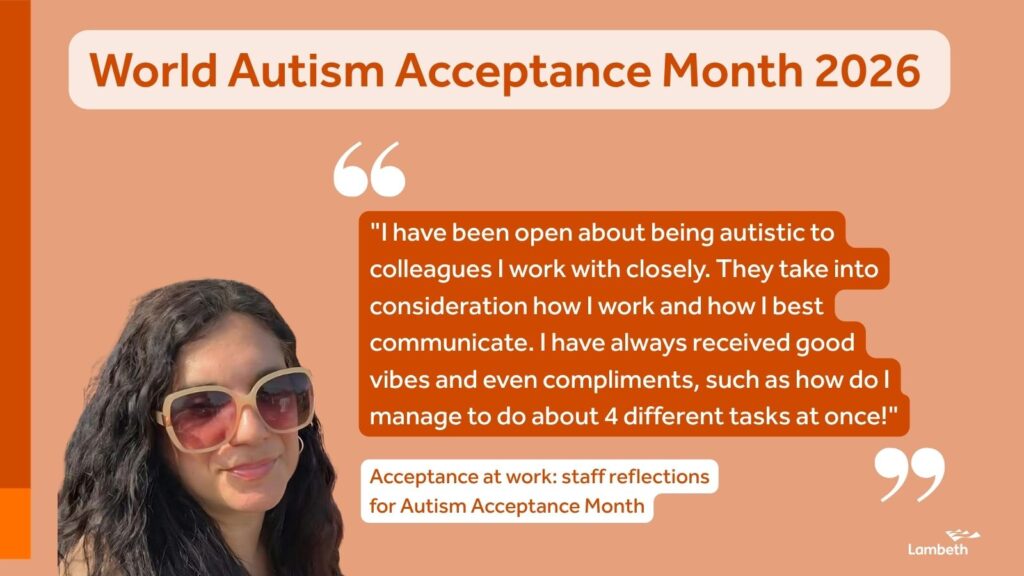
“In 2024, I became a co-chair of the Staff Disability Forum at Lambeth Council, and while externalising your identity at work is a very personal choice, I have been open about being autistic to colleagues I work with closely. They take into consideration how I work and how I best communicate.
“I have always received good vibes and even compliments, such as how do I manage to do about 4 different tasks at once! Humour goes a long way, always in the ‘laugh with you’ fashion.
“To add to all that, I am a parent to neurodivergent children (autistic and ADHD mix), with varying needs and abilities, some of which are now adults, and so I feel strongly that inclusivity and acceptance is vital in all arenas of life.”
– Joanna, Co-Chair of the Staff Disability Forum, Lambeth Council.
“As someone who is neurodivergent (ADHD), I sometimes rely on familiar shortcuts when working quickly. When I shared a presentation celebrating public figures with autism, a colleague gently pointed out that the examples I’d used weren’t very diverse.
“The feedback was clear, specific and kind. There was no assumption of intent and I was given time to reflect and improve the work. That approach made it easier for me to process what was being said and improve it, rather than becoming anxious or defensive.
“This kind of supportive feedback is a simple adjustment, but it makes a real difference for neurodivergent colleagues. It supports learning, and helps people do better work. Being given the space to revisit and improve my work helped me feel trusted, valued and supported — and it’s an approach that benefits everyone, not just autistic colleagues.”
– Ana, Business Support Officer, Lambeth Council.
“It’s very hard managing disabilities and health conditions, let alone holding down a full-time job. Yesterday my anxieties got the best of me in a face to face service meeting. I asked for the agenda in advance, I asked questions from senior staff, and everything seem to go well for me.
“When a meeting was delayed due to technical issues, my anxiety escalated and I stepped out. I asked a colleague if we could walk and talk for a few minutes. Lucky for me, the member of staff had a medical background, so completely understood ASD and ADHD.
“We walked around the Town Hall and talked. The light chat helped a great deal, and the fact the member of staff ‘got me’ helped me get myself together and return to the meeting.”
“The chair of the meeting whispered to ask if I was okay, and I was. The chair then asked if everyone could reintroduce themselves. Everyone did, without a fuss, or objection.
“That started off bad, but with the help of another staff member, and the team, I felt included and was able to take part in the meeting. Every day is a school day!!”
Lee, Commissioning Support Officer & Co-Chair of the Staff Disability Forum, Lambeth Council.
Why this matters
Autism is a lifelong difference in how people experience the world. Many people say that misunderstandings, not autism itself, create the biggest barriers at work. By learning from each other and making small adjustments, we can build a workplace where all colleagues and residents feel valued, supported and able to thrive.
Thank you
A huge thank you to Ana, Joanna and Lee for sharing your stories and helping us foster a more inclusive culture across Lambeth.
A Lambeth Together priority
Lambeth’s All‑Age Autism Strategy, sets out our shared commitment to improving understanding, acceptance and inclusion for autistic people across the borough. It reflects Lambeth Together’s priority to help autistic people thrive at home, in education, at work and in their communities, through better awareness, equitable support and more inclusive environments. Read about our Learning Disabilities and Autism Programme.
Useful links
Download the National Autistic Society’s guide to supporting neurodivergent colleagues here.