

Our priority outcome: to increase in the number of people in education, training, volunteering or employment.
A sense of purpose is central to good mental health and many people get this from studying, work or volunteering. The Living Well Network Alliance works with partners to help people develop themselves as well as get into and sustain meaningful work and training.
Context and key challenges
People with serious mental illness (SMI) are far less likely to be employed than the general population. A 2023 study by King’s College London showed that eight out of ten people with SMI were unemployed, compared with less than one in ten of the general population. The same study also revealed that two thirds of people with SMI also have a disability (compared with less than a fifth of the general population) and 6 out of 10 with SMI suffer poor health (compared with six out of 100 of the general population). [1]
[1] Bringing data together to understand employment, disability and health among people with severe mental illness | Feature from King’s College London (kcl.ac.uk)
The situation for people with severe mental illness (SMI) is far worse, with less than one in ten (8%) being employed according to NHS England (Community Mental Health Services, 2023) despite the fact that 8 out of 10 people with SMI want to work.
We reviewed a number of our existing employment support contracts, involving people who use our services in this process, and concluded that they were not providing value for money. We ended these contracts and will use the money saved to reinvest in support for adult mental health in Lambeth.
What we offer
The Living Well Network Alliance provides a range of support to help people find jobs, and for those in work to keep their jobs. We also offer talking therapies, psychiatric and other day-to-day support to keep people well so they have the best chance of staying in training or employment. In addition, we provide some jobs themselves and access to jobs.
Individual Placement and Support (IPS) service
Our main employment support service is the new Individual Placement and Support (IPS) service, which was launched in summer 2022. This service works with anyone who we support that wants to work or stay in their job.
Employment Placements
We also provide a number of work placements with our close partner Mosaic Clubhouse. Known as Transitional Employment Placements (TEPs) these part-time, paid roles provide skills, references and above all, confidence for those looking to get into, or back into, paid employment.
Our impact
In 2024/25 the IPS service worked with 360 people with serious mental illness to seek employment, successfully supporting 56 of these people into paid employment, in roles including nursing, marketing and engineering. All the jobs we support people into are things that they are interested in and pay at least the London Living Wage.
Our next steps
We are expanding our IPS service, supporting more people into paid employment and more people to stay in employment.
We will explore how we can introduce entry level jobs so that we can ‘grow our own’, developing and training people on the job.
Transitional Employment Placement case study:
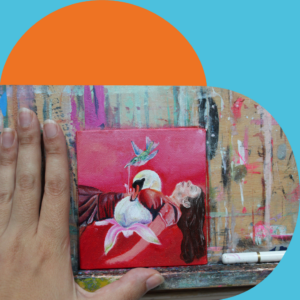
“I was diagnosed with psychosis as a teenager and then diagnosed with schizophrenia. “I went to university to study art shortly after this and although it was a struggle, I did enjoy my time there and reaped many benefits of the education. I did various volunteer work, placements and paid work relating to art and working with people. I then did a TEP (Transitional Employment Placement) organised by Mosaic Clubhouse, doing reception and admin work. There was an art gallery in the building and I assisted with that. I’ve been running the SHARP art gallery (linked to South London & Maudsley NHS Foundation Trust, SLaM, and now based at Brixton’s Blue Star House) for eight years. I’ve curated 38 exhibitions and many events. I’m passionate about the work because I believe that art is a vehicle for curiosity, which plays a key role in having a passion for life. I get a lot of job satisfaction seeing the impact engaging in the gallery has on people. It’s not exclusively for people who use or have used mental health services, it’s for anyone who feels art will help with their mental health. It builds confidence and creates a safe space for socialising and networking.
“Outside of this job I do other paid work and projects relating to art and curating. I’m the only person working on the gallery, which allows me a degree of freedom to mould it and adapt it according to individual artists who come along. Purpose is really important to me and bear this in mind when supporting others.”